The First Report of Presence
of Mesobuthus eupeus (C.L. Koch, 1839)
(Scorpiones: Buthidae) in
the Central Anatolia
Ayşegül KARATAŞ and Ahmet KARATAŞ
Ege Üniversitesi, Fen Fakültesi, Biyoloji Bölümü, Zooloji Anabilim Dalı,
TR-35100 Bornova, Izmir-TÜRKİYE. E-mail: karatash@scientist.com
Abstract: The present study is based on specimens of Mesobuthus eupeus (C.L.
Koch, 1839) collected in Kayseri, Nevşehir and Niğde provinces of Asia Minor.
The species is recorded for the first time in the Central Anatolia, which is
the western limit of its distribution.
Keywords: Mesobuthus eupeus, Buthidae, Scorpiones,
Anatolia.
Introduction: The
genus Mesobuthus Vachon, 1950
of Irano-Turanian Subregion is represented with three species, viz. M.caucasicus (Normann, 1840), M.eupeus (C.L. Koch, 1839) and M.gibbosus (Brullé, 1832), in
Anatolia. Of these, Balkono-Anatolian species, M.gibbosus is common in west of Anatolian Diagonal except
for both of the coasts of Black Sea and Marmara Sea; however other two species,
viz. M.caucasicus and M.eupeus, have been known from
several localities in the eastern and south-eastern Anatolia regions (Birula,
1917; Crucitti, 1993, 1998; Kinzelbach, 1984; Kovařík, 1996; Vachon, 1951,
1966; Vachon and Kinzelbach, 1987). The later species is widespread in the
western Palaearctic Region and it ranges throughout Eastern Anatolia, Georgia,
Azerbaidjan, and other Caucasian countries, turning northwards to southern
Russia (north-western Caucasus) and Ukraine; it reaches though Turkmenistan,
Uzbekistan, Tadzikistan, Kazakhistan, Mongolia to East Turkistan and China,
passing Syria, Iraq southwards into Iran, Afghanistan and Pakistan up to India
(Fet, 1988 [1989]; Kinzelbach, 1975; Kovařík, 1998).
The purpose of the
present paper is to give some new distributive information, including the first
record for the Central Anatolia, about M.eupeus
in Anatolia and contribute to the records on its chorology.
Material and methods:
During the period of years between 1995-2000 to establish Turkish
scorpio-fauna, specimens of M.eupeus
were found in three provinces (Kayseri, Nevşehir and Niğde) of the central
Anatolia (Fig. 1). The voucher
samples were put into 70 % of etanol and they have been deposited in senior
author’s collection in ZDEU-S (Zoology Department Museum of Ege University,
Scorpion Section). All measurements were taken to the tenth of a millimetre by
a calliper.
Result:
Specimens examined: Total 30 specimens (14 ♀♀+17 ♂♂). Kars,
near Castle of Kars, 1 ♂ (12.IX.2000); Sarıkamış District, 2
♂♂+4 ♀♀ (16.IX.2000); Kayseri: Kocasinan,
Boztepe 2 ♀♀ (ZDEU-S 1998/05-06; 30.V.1998); Nevşehir: Derinkuyu,
Goble stream vicinity 2 ♂♂ (ZDEU-S 1997/44-45; 05.VIII.1997); Niğde-Kayseri
road, Ca. 10 km, 2 ♂♂+1 ♀ (1996/24-26; 2.V.1996); between
Ovacık and Uluağaç villages, 2 ♂♂+1 ♀ (1996/27-29; 3.V.1996);
Gümüşler 1 ♀+1 ♂ (1997/38-39; ?.VI.1997); ibid, near Gümüşler Dam Lake 2 ♀♀ (1997/33-34;
07.V.1997); near Koyunlu district, 1 ♂ (1997/49; 15.XII.1997); campus of
Niğde Univ., 1 ♂ (1998/44; 15.X.1998); Bor district, Yediodalar vicinity,
2 ♀♀ (1995/13-14 22.X.1995); Balcı village, 1 ♂ (1996/102;
20.VII.1996); Pınarbaşı vicinity, 2 ♂+1 ♀ (1996/14, 16-17,
24.III.1996); Bahçeli district, 1 ♂ (1996/18; 23.IV.1996).
Habitat: All these samples, except for one found at night by UV lamp, were
collected under the stones. The localities, with altitudes of 900-1300 metres,
has a typical continental climate and step vegetation.
Taxonomical
Evaluation and Comments:
M.eupeus and M.caucasicus are
distinguished from M.gibbosus with 10
keels on fourth segment of its metasoma, by have 8 keels on this segment of
them. M.eupeus is also different from
M.caucasicus, by their total length
(from chelicerae to end of metasoma) and numbers of diagonal rows of granules
on movable finger of pedipalps. The former species has most 12 diagonal rows
and length of up to 50 mm and the later one has 13 or 14 diagonal rows and
length of 60 to 80 mm for adults.
Adult females are larger than males (see Table.1). Males have more pectin
teeth and this number is 21 to 28 for males and 16 to 23 for females. So, males
have longer pectines. Metasoma or tail in males is longer and wider than which
of same total length females. Measurements taken from females and males of M.eupeus are shown in Table.1.
Up to now, M.eupeus has been known from the Eastern- and South-eastern
Anatolia. Braunwalder and Fet (1999) reported that the populations of Mesobuthus in Central Anatolia may
belong to “eupeus” group and not to
the “gibbosus” group. In the present
study, we partly confirm their opinion and so, the species is reported for the
first time in this region. In the other hand, M.gibbosus are common and simpatrically found with M.eupeus in the Central Anatolia. With
respect to new findings, the area forms the western
limit of total area of M.eupeus.
According to Birula (1917), specimens from
Kars Provinces and its environs belong to nominate subspecies and Irak is
inhabited by iranus Birula, 1917.
However, Kovařík (1996, 1998) considered that
nominate form ranges in Anatolia. When we compared the Central Anatolian
samples with those from Kars in our collection, former has more light yellow
colour on both of ventral and dorsal surfaces and darker pigmented on carapace
and mesosoma.
Acknowledgements: We wish to thank Doctorant Tuncay Türkeş of Hacettepe University and
Biol. Hasan Karakaya for helps in collection. We are grateful to Dr. Victor Fet
for correction English text.
Bibliography
Birula, A.A., 1917, Arthrogastric Arachnids of Caucasia. I: Scorpions, Ann. Caucasian Museum, Tiflis, A 5, 253
pp. [in Russian]. English translated by J. Salkind, Edited by E. Rabinovitz, Israel
Program for Scientific Translation, No. 1206, Jerusalem, 1964, v+170 pp.
Braunwalder, M.E. and Fet, V., 1999, The
scorpions (Arachnida: Scorpiones) of the Eastern Mediterranean area: Current
problems in taxonomy and biogeography, 8th
International Congress on the Zoogeography and Ecology of Greece and Adjacent
Regions, (Kavala (Macedonia), Greece, 17-21 May 1999), Abstracts, pp.
25-26.
Crucitti, P., 1993, Some topics on distribution patterns of the genus Mesobuthus in the Near East based on ecological data (Scorpiones:
Buthidae), Biologia Gallo-Hellenica,
20 (1): 69-74.
Crucitti, P., 1998, The
scorpions of Anatolia: Biogeographical patterns (Scorpiones), XXXI Congresso Società Italiana di
Biogeografia – Biogeografia dell’Anatolia – Roma, 29-31 ottobre 1998, p.
34.
Fet, V., 1988 [1989], A
catalogue of scorpions (Chelicerata: Scorpiones) of the USSR, Riv. Mus. civ. Sci. Nat. ‘E.Caffi’ Bergamo,
13: 73-171.
Kinzelbach, R., 1975, Die Skorpione der Ägäis:
Beträge zur Systematik, Phylogenie und Biogeographie. –The Egean Scorpions, Zool. Jb., Syst. Bd., 102: 12-50.
Kinzelbach, R., 1984, Die Skorpionssammlung des Naturhistorischen Museums
der Stadt Mainz. –Teil II: Vorderasien,
Mainzer Naturw. Archiv, 22: 97-106.
Kovařík, F., 1996, First report of Compsobuthus matthiesseni (Scorpionida:
Buthidae) from Turkey, Klapalekiana,
32: 53-55.
Kovařík, F., 1998, Štíři [Scorpions], Vydalo, Nakladatelství Madagaskar, Jihlava, 175 pp. [in Czech].
Vachon, M., 1951, A propes de quelques Scorpions de Turquie collectés par M. le
Professeur Dr. Curt Kosswig. –Prof. Kosswig tarafından Türkiye’de toplanan
akrepler hakkında, İ.Ü. Fen Fak. Mec., B, 16 (4): 341-344.
Vachon, M., 1966, Liste des scorpions connus en Egypte, Arabie, Israël, Liban, Syrie,
Jordanie, Turquie, Irak, Iran, Toxicon,
4: 209-218.
Vachon, M. and Kinzelbach, R., 1987, On
the taxonomy and distribution of the Scorpions of the Middle East, pp. 91-103,
In: Krupp, F., Schneider, W. and
Kinzelbach, R. (Eds.), Proceedings of the Symposium on the Fauna and
Zoogeography of the Middle East, Mainz, 1985. Beihefte zum Tübinger Atlas des
Vorderen Orients, Reihe A (Naturwissenschaften), 28, Dr. Ludwig Reichert
Verlag, Wiesbaden, 338 pp.
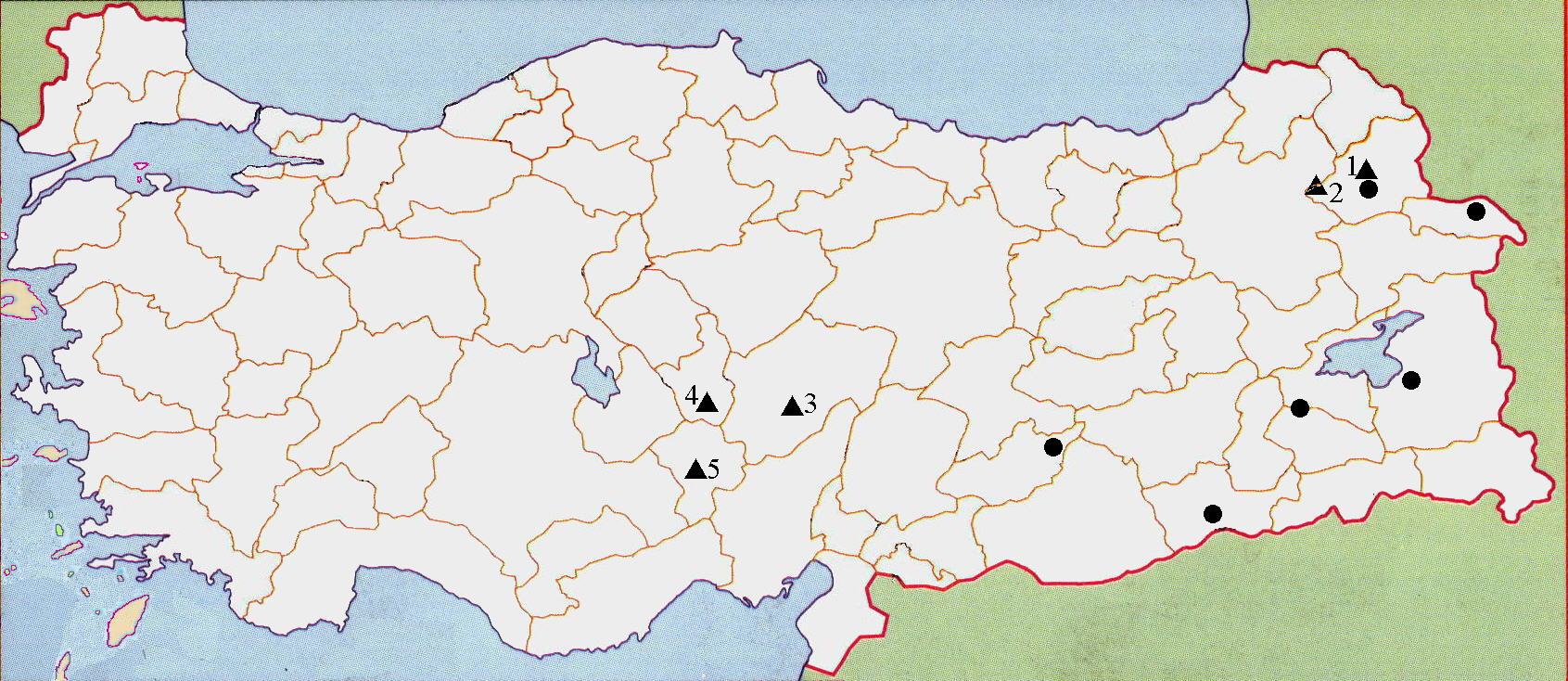
Table.1. Some
measurements taken from females and males specimens of M.eupeus.
Characters
|
N |
♀♀ |
|
♂♂ |
|||||||
|
mean |
min |
max. |
±SD |
|
N |
mean |
min |
max. |
±SD |
||
|
Total length |
5 |
46,14 |
41,5 |
49,3 |
2,89 |
|
5 |
36,88 |
31,8 |
39,7 |
3,54 |
|
Metasoma length |
5 |
28,24 |
27,0 |
29,5 |
1,15 |
|
5 |
22,42 |
18,5 |
25,0 |
2,66 |
|
Carapace length |
5 |
5,56 |
5,2 |
5,9 |
0,26 |
|
5 |
4,24 |
3,7 |
4,8 |
0,42 |
|
Femur length |
5 |
4,52 |
4,3 |
4,7 |
0,18 |
|
5 |
3,28 |
2,7 |
3,6 |
0,36 |
|
Femur breadth |
5 |
1,56 |
1,4 |
1,7 |
0,13 |
|
5 |
1,20 |
1,0 |
1,4 |
0,14 |
|
Chela length |
5 |
9,06 |
9,0 |
9,3 |
0,13 |
|
5 |
7,26 |
6,0 |
8,1 |
0,78 |
|
Chela breadth |
5 |
2,44 |
2,4 |
2,5 |
0,05 |
|
5 |
1,88 |
1,2 |
2,3 |
0,43 |
|
Fixed finger length |
5 |
4,12 |
3,5 |
4,5 |
0,39 |
|
5 |
3,40 |
3,0 |
3,8 |
0,29 |
|
Fixed finger breadth |
5 |
5,56 |
5,0 |
5,9 |
0,35 |
|
5 |
4,68 |
3,8 |
5,3 |
0,56 |
|
III. Tail segment length |
5 |
3,94 |
3,5 |
4,5 |
0,40 |
|
5 |
3,06 |
2,5 |
3,4 |
0,35 |
|
III. Tail segment breadth |
5 |
3,38 |
3,3 |
3,5 |
0,11 |
|
5 |
2,70 |
2,2 |
3,0 |
0,33 |
|
V. Tail segment length |
5 |
6,10 |
5,7 |
6,6 |
0,36 |
|
5 |
4,84 |
4,0 |
5,4 |
0,52 |
|
V. Tail segment breadth |
5 |
3,22 |
3,0 |
3,4 |
0,18 |
|
5 |
2,56 |
2,2 |
2,9 |
0,25 |